Graduating with a Civil Engineering degree is an important milestone, but it is only the beginning of your professional journey. Becoming a competent Structural Engineer requires more than academic qualifications. It demands a strong foundation in engineering principles, continuous practice, and a commitment to lifelong learning.

The following skills are considered essential for anyone who plans to build a successful career in structural engineering.
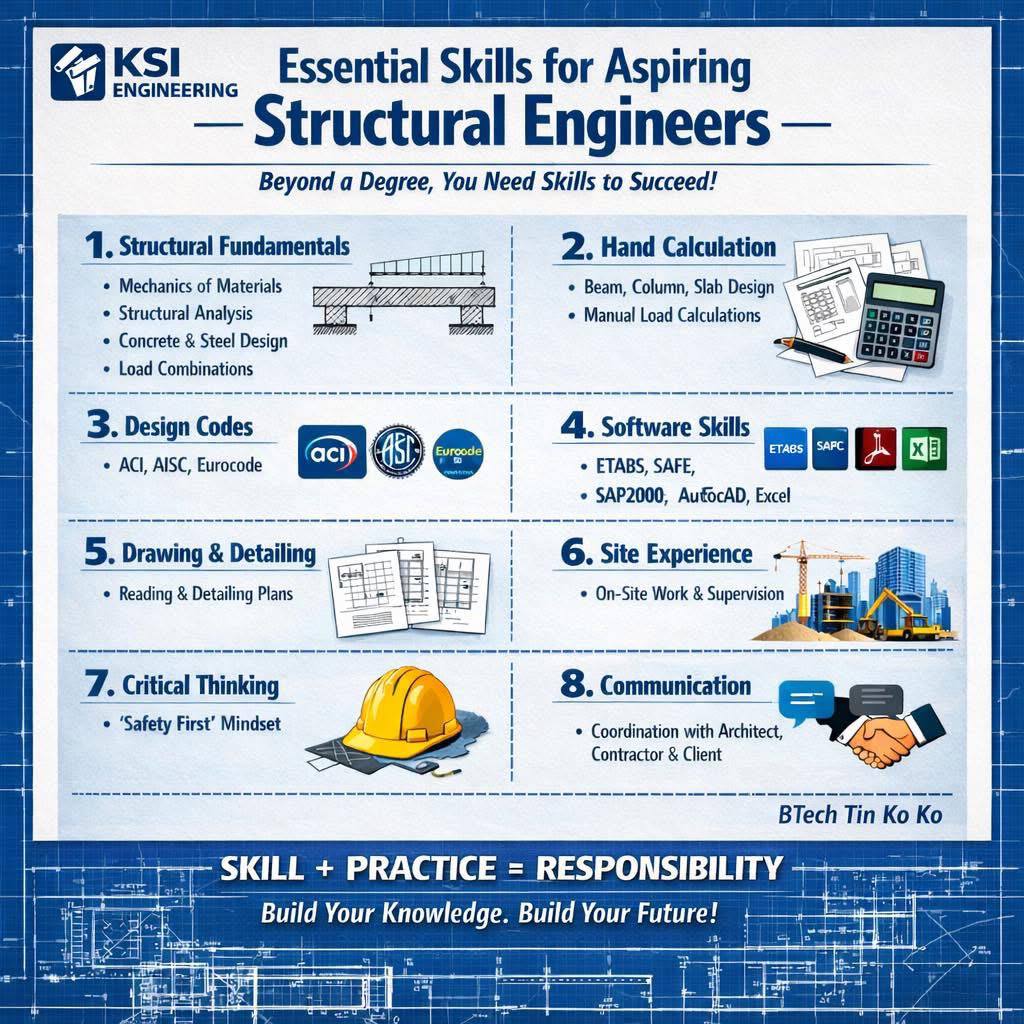
1. Master Structural Engineering Fundamentals
Before relying on engineering software, every Structural Engineer should understand the core principles behind structural design.
Key subjects include:
- Mechanics of Materials
- Structural Analysis
- Reinforced Concrete Design
- Steel Structure Design
- Load Combinations
- Structural Design Philosophy
Software can assist with calculations, but it cannot replace engineering judgment. A strong understanding of these fundamentals enables engineers to identify errors, verify results, and make sound design decisions.
2. Develop Strong Hand Calculation Skills
Hand calculations remain an important part of engineering practice.
A Structural Engineer should be able to perform basic calculations for:
- Beam Design
- Column Design
- Slab Design
- Footing Design
- Load Calculations
- Shear Force Diagram (SFD)
- Bending Moment Diagram (BMD)
- Deflection Checks
Even when software is available, manual calculations provide an effective way to validate design outputs and improve engineering confidence.
3. Understand Structural Design Codes
Professional engineers must understand not only the requirements of design codes but also the engineering concepts behind them.
Commonly used standards include:
- American Concrete Institute (ACI)
- American Institute of Steel Construction (AISC)
- Myanmar National Building Code (MNBC), where applicable
- Other local or international codes depending on the project
Following code provisions without understanding their purpose may lead to incorrect engineering decisions.
4. Become Proficient in Engineering Software
Modern structural engineering relies heavily on specialized software.
Useful software includes:
- ETABS
- SAFE
- AutoCAD
- Microsoft Excel (Advanced)
- Other structural analysis and detailing tools
Remember that software is a tool. Engineers remain responsible for interpreting the results and making final design decisions.
5. Improve Drawing Reading and Detailing Skills
A Structural Engineer should be comfortable reading and interpreting structural drawings.
Important abilities include:
- Reading structural drawings accurately
- Understanding reinforcement detailing
- Reviewing construction drawings
- Identifying potential detailing issues before construction
- Solving site-related drawing questions efficiently
6. Gain Practical Site Experience
Practical construction experience is invaluable.
Site exposure helps engineers understand:
- Reinforcement installation
- Formwork systems
- Concrete placement and curing
- Construction sequencing
- Coordination with contractors and site engineers
Practical knowledge allows engineers to design structures that are not only safe but also practical to construct.
7. Practice Critical Thinking and Professional Responsibility
Every structural design decision has real-world consequences.
Engineers should always prioritize:
- Public safety
- Structural reliability
- Ethical responsibility
- Engineering judgment
- Risk awareness
Safety should always be the highest priority throughout the design process.
8. Build Strong Communication Skills
Technical knowledge alone is not enough.
Structural Engineers should be able to communicate effectively with:
- Architects
- Contractors
- Site Engineers
- Clients
- Project Managers
The ability to explain complex technical concepts in simple language is a valuable professional skill.
Final Thoughts
A Civil Engineering degree opens the door to a career in structural engineering, but professional success depends on continuous learning and practical experience.
Developing strong technical knowledge, practical skills, engineering judgment, and professional responsibility will help you become a more capable and confident Structural Engineer.
Invest in your knowledge today, and your future career will benefit from it.
BTech Tin Ko Ko
KSI Engineering